

Circle, the company behind USDC, just previewed a feature called Arc Privacy that lets transactions happen on its blockchain without posting every detail to the public. It is a clear signal from one of the most compliance-focused companies in crypto: transparent-by-default blockchains are a problem, and privacy is a requirement for serious financial activity, not a fringe demand.
That validation matters. But there is a catch worth understanding before you assume "private USDC" means what you think it means. Arc Privacy hides your data from the public while keeping it visible to authorized parties like auditors and compliance teams. That is one kind of privacy. A private USDC swap that breaks the on-chain link between sender and receiver is a different kind. This post explains the difference, because the word "private" is about to get used for two very different things.
What is Arc Privacy?
Arc Privacy is a proposed confidential smart contract engine for Arc, Circle's stablecoin-focused blockchain. It is currently on testnet, with scope and timeline subject to change. The idea is opt-in: developers choose which workflows stay confidential, such as payroll or treasury, instead of putting an entire application into private mode.
The design goal, in Circle's own framing, is confidentiality from the public but not from the auditor. Sensitive details stay off the public chain during execution, while authorized parties such as compliance teams and regulators retain access to the data under predefined governance rules. For an institution, that is exactly right. A company's payroll should not double as public market data, but its finance and audit teams still need to see everything.
So what's the catch for a regular user?
The catch is in who holds the keys to your data.
Circle has floated a consumer use case where you could hold and spend USDC without your wallet balance and payment history being publicly traceable. That sounds like the privacy most people actually want. But under the governed model, "not publicly traceable" is not the same as "private." Your data is hidden from the crowd, and still fully visible to Circle and the authorized parties operating under the governance rules. The visibility did not disappear. It got permissioned.
For an enterprise hiding payroll from competitors, that is a feature. For an individual who simply does not want their entire financial life mapped, it is worth asking a sharper question: private from whom?
Governed privacy vs breaking the link
There are two fundamentally different things the industry now calls privacy.
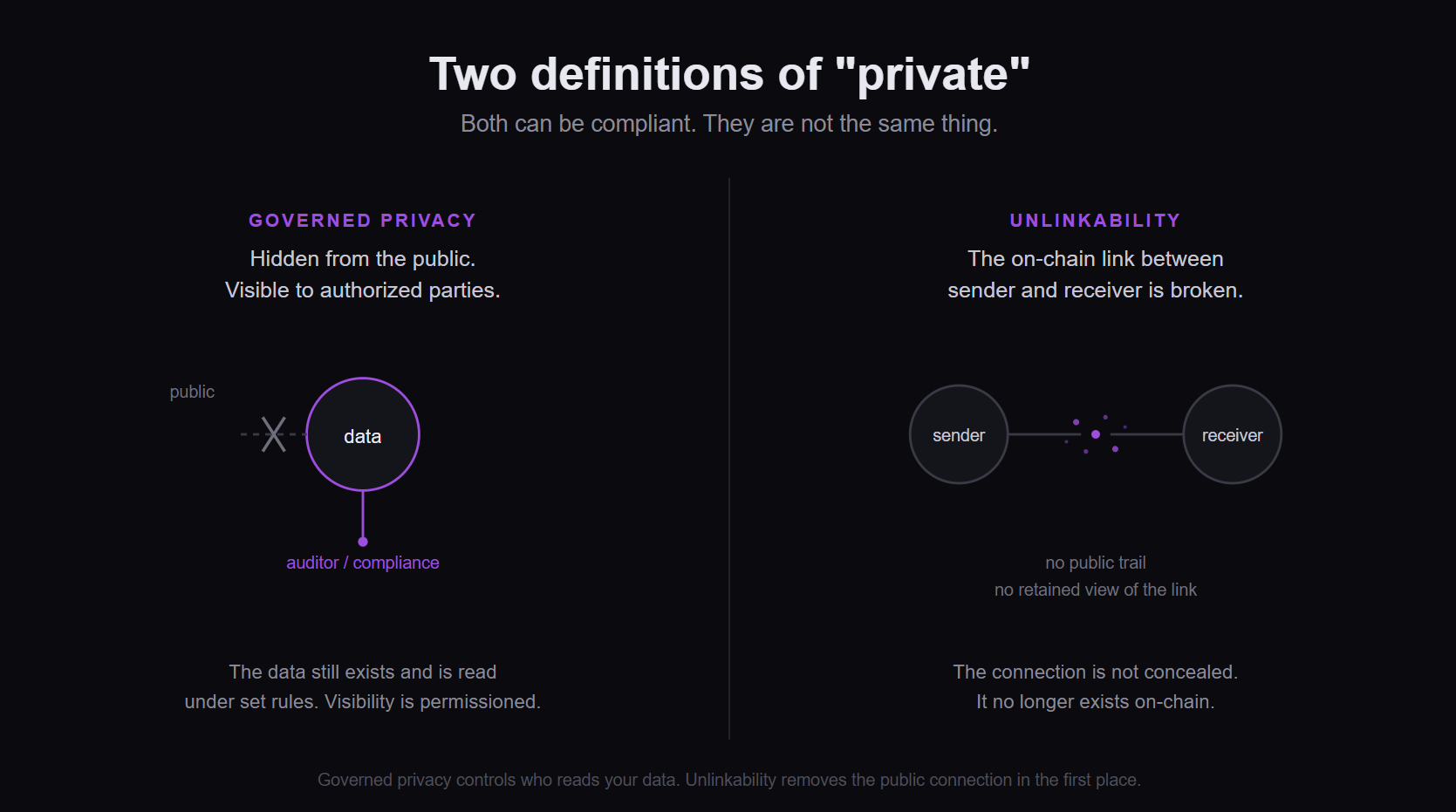
The first is selective disclosure, or governed privacy. Your activity is concealed from the public but readable by authorized parties under set rules. This is the Arc Privacy model. It answers the question "who can see what, when, and under whose authority" with a managed list.
The second is unlinkability. The public on-chain connection between the sending wallet and the receiving wallet is broken, so the transfer cannot be traced from one to the other on a block explorer by anyone, with no authorized-party view retained over that link. This is what a private cross-chain swap does.
Houdini Swap is built on the second model. A private swap routes funds through two separate compliant exchange partners with an intermediary chain between them. Each partner sees only its half of the route, and the on-chain link between sender and receiver is fully broken. There is no permissioned list with a window into that link, because the link itself no longer exists on-chain.
This is the part that separates the two models, and it is worth being precise about. Governed privacy means your data sits in a system where authorized parties can read it at any time, under the rules, whether or not you have done anything wrong. Unlinkability has no such standing access. There is no pre-set database and no back door waiting to be opened. If a criminal investigation is opened, the exchange partners in the route cooperate with legal authorities, the same as any regulated exchange. But that cooperation is triggered by an actual investigation into an actual crime, not by a permanent window that exists by default. The difference is between data that is always visible to a list, and data that is only ever reached through due process after a crime has been committed.
Both models are compliant. The difference is structural, not regulatory. Governed privacy keeps your data and controls who reads it. Unlinkability removes the public connection in the first place, and answers lawful requests through the exchange layer only when an investigation requires it.
Is a private USDC swap compliant?
Yes. This is the part people get wrong about the second model, so it is worth being precise. A private swap through Houdini runs every transaction through vetted exchange partners that perform AML and KYT screening. Private transactions are capped at $100K, and exchange partners cooperate with legal authorities if an investigation requires it. Using a private swap does not taint a wallet or get it blacklisted.
The compliance lives at the exchange layer, where regulation already operates, rather than in a permanent public record or a governed access list. You get a private USDC transfer that breaks the on-chain trail, screened for compliance the same way a regulated exchange screens any transaction. The track record behind that approach: more than $3 billion in volume across 120+ chains over three years, with zero user funds lost, and three separate $50K bounties that challenged anyone to trace a transaction. None were collected.
Which kind of privacy do you actually want?
If you are an institution that needs to hide operational data from competitors while staying fully auditable, governed privacy on a network like Arc is built for you. That is a real and useful product.
If you are a person or a team that does not want a permanent public map of your wallets, your counterparties, and your balances, and you do not want that visibility simply relocated to an authorized list, then unlinkability is the model that matches the intent. The point is not that one is good and the other is bad. The point is that they are not the same thing, and "private USDC" could mean either.
Circle just made the strongest case yet that privacy belongs in onchain finance. The next question is whose definition of privacy you are signing up for.
FAQ
Does Arc Privacy make USDC anonymous?
No. Arc Privacy hides transaction details from the public while preserving access for authorized parties such as auditors and compliance teams. It is selective disclosure, not anonymity. The data is concealed from the crowd, not removed from view entirely.
What is the difference between governed privacy and a private swap?
Governed privacy conceals your data from the public but keeps it readable by an authorized list under set rules. A private swap breaks the public on-chain link between the sending and receiving wallets, so the connection cannot be traced by anyone, with no retained view over that link. One controls who sees the data; the other removes the public connection.
Can I make a private USDC transfer that is also compliant?
Yes. A private USDC swap through Houdini routes the transfer through exchange partners that run AML and KYT screening, with private transactions capped at $100K. Compliance happens at the exchange layer rather than through a permanent public record.
Is Arc Privacy live?
No. As of June 2026 it is a proposed feature on testnet, with Circle stating that scope and timeline are subject to change.
Why does Circle building privacy matter for the crypto privacy debate?
Because Circle is one of the most compliance-focused companies in crypto, and it has now argued that public-by-default blockchains are unworkable for real financial operations. That reframes privacy as a mainstream requirement rather than a fringe concern, regardless of which privacy model a user chooses.
