
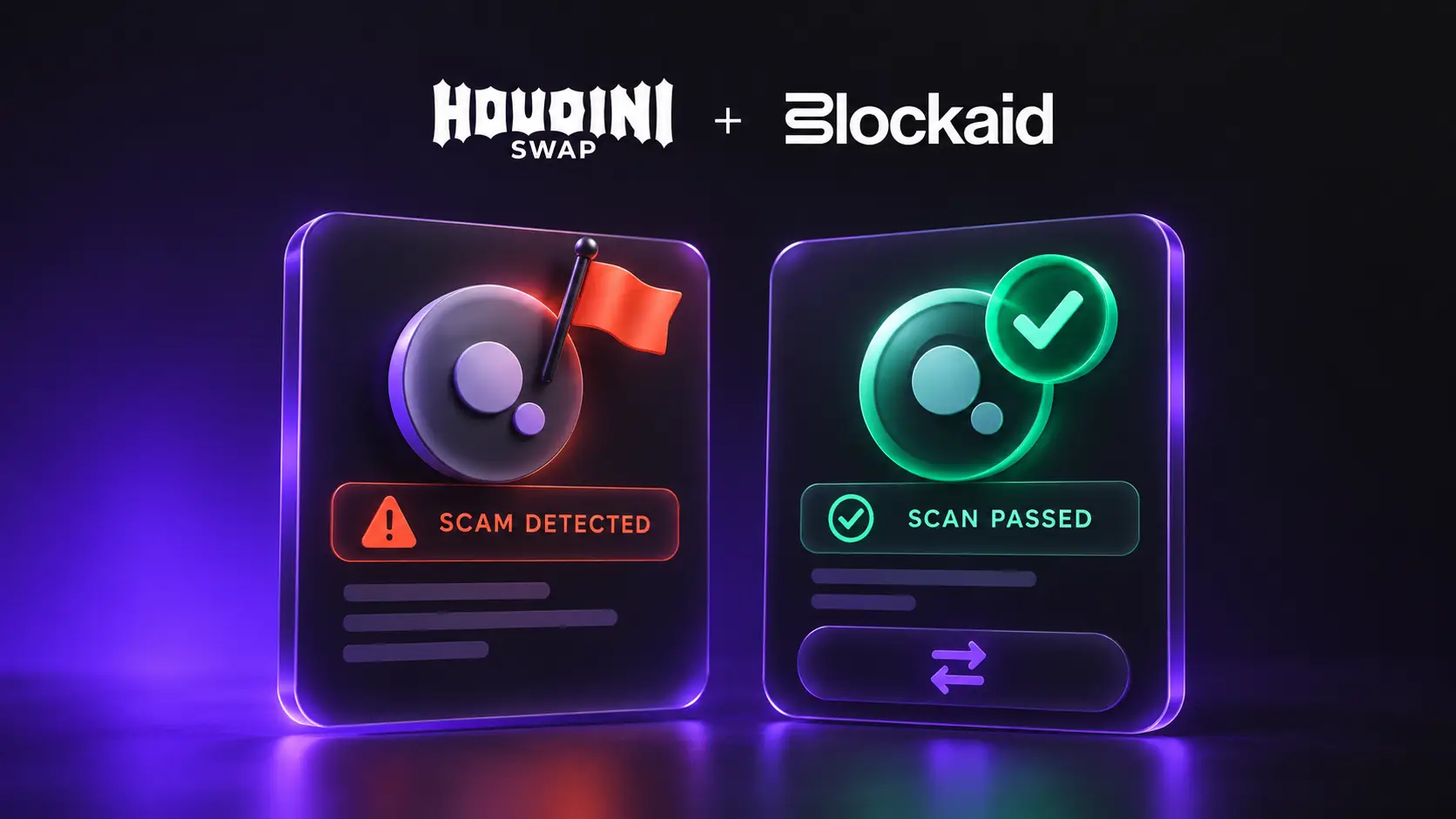
New tokens launch every day, on every chain. Most are just new tokens. Some are traps.
A honeypot that lets you buy but never sell. A rugpull that drains the pool the moment enough buyers pile in. A fake that copies a real token's name and logo. You won't always spot them from the chart, and by the time you do, it's usually too late.
Here's how the most common scam tokens work, the checks worth running before you swap, and how Houdini now scans tokens for you with Blockaid.
Three scam tokens to watch for
Honeypots
A honeypot lets you buy but blocks you from selling. The restriction is hidden in the contract code: a sell function that always fails, a blacklist that catches every buyer, or a sell tax set close to 100%.
Warning signs: plenty of buys on the chart but almost no sells, or a price that only goes up.
Rugpulls
In a rugpull, the creator pulls the liquidity out of the pool, mints a flood of new tokens, or dumps a large hidden allocation. Holders are left with tokens nobody can buy.
Warning signs: liquidity that isn't locked, a few wallets holding most of the supply, or a contract that lets the owner mint more tokens or change fees at will.
Impersonation tokens
Impersonators copy the name, ticker or logo of an established token and wait for someone to grab the wrong contract. They often show up right after a big launch or airdrop, when people are searching in a hurry.
Warning signs: a contract address that doesn't match the official one, very little trading history, or a token you found through a DM or a reply rather than the project's own channels.
Checks to run before you swap
None of these is a guarantee on its own. Together, they catch most obvious traps.
- Get the contract address from the source. Use the project's official site or verified accounts, not a search result, a DM or a reply under a post.
- Check the liquidity. Is there enough to sell into, and is it locked? Unlocked liquidity can disappear in one transaction.
- Look at the holders. If a handful of wallets hold most of the supply, they can crash the price whenever they like.
- Read what the contract allows. Watch for owner functions that mint tokens, change fees, pause trading or blacklist wallets.
- Look for sells, not just buys. If almost nobody has managed to sell, assume you won't either.
- Start small. If a token is new to you, buy a little and try selling it before you commit more.
That's a lot to check every time, especially on a token that launched an hour ago. That's where scanning comes in.
How Houdini checks tokens for you
Houdini now runs every token it checks through Blockaid's Token Scanning. It’s part of Blockaid’s End User Protection suite, the same protection wallets and exchanges use to stop malicious activity before it reaches their users. You can read the full story in Blockaid's announcement.
Here's what that means when you swap:
- Real-time verdicts. Houdini sends the token's address and chain, and gets a risk verdict back in the same moment, along with the specific risks behind it.
- The big three, flagged. Token Scanning flags honeypots, rugpulls and impersonation tokens.
- More than one signal. Each check looks at what the contract allows, how the token has traded and where its creator's funds came from. A scam that hides in one place usually shows up in another.
- Network-wide threat data. A malicious token caught in another app arrives at Houdini with its risk already known.
- No extra step. The check sits inside Houdini's interface, even when you paste in the contract address of a token that launched minutes ago.
Your privacy stays intact
A scan only needs a token's address and chain. Houdini shares nothing about who's swapping, which wallets are involved or where the funds are going. Blockaid never sees who's trading, and private swaps stay private.
Safer swaps. Same privacy.
Why this matters across chains
Cross-chain swaps open up more tokens, on more networks, faster than ever. They also open up more risk. Blockaid's H1 2026 Onchain Security Report found that bridges were the single largest source of dollar losses in the first half of the year.
The more chains you move across, the more places a bad token can hide. Houdini is built to make cross-chain swaps private and compliant, and now there's an independent check on the tokens themselves.
That sits alongside the compliance controls already built into every swap, including sanctions screening and real-time transaction monitoring. See how Houdini approaches privacy and compliance.
Swap with a second pair of eyes
Paste the contract. Get the verdict. Swap privately.
FAQ
What is a honeypot token? A token whose contract lets you buy but stops you from selling, usually through hidden code, a blacklist or an extreme sell tax.
How can I tell if a token is a rugpull? Look for unlocked liquidity, a few wallets holding most of the supply, or owner functions that can mint tokens or change fees. None of these proves a rugpull, but each is a reason to be careful.
Does Houdini check tokens before I swap? Yes. Houdini uses Blockaid's Token Scanning to return a risk verdict on the token, inside Houdini's interface.
Does token scanning affect my privacy? No. A scan only uses the token's address and chain. Nothing about you, your wallets or where your funds are going is shared with Blockaid.
Is a token safe if it passes the scan? A clean result means no known risks were found, not that a token can't lose value or turn bad later. Keep running your own checks, especially on brand-new tokens.
