
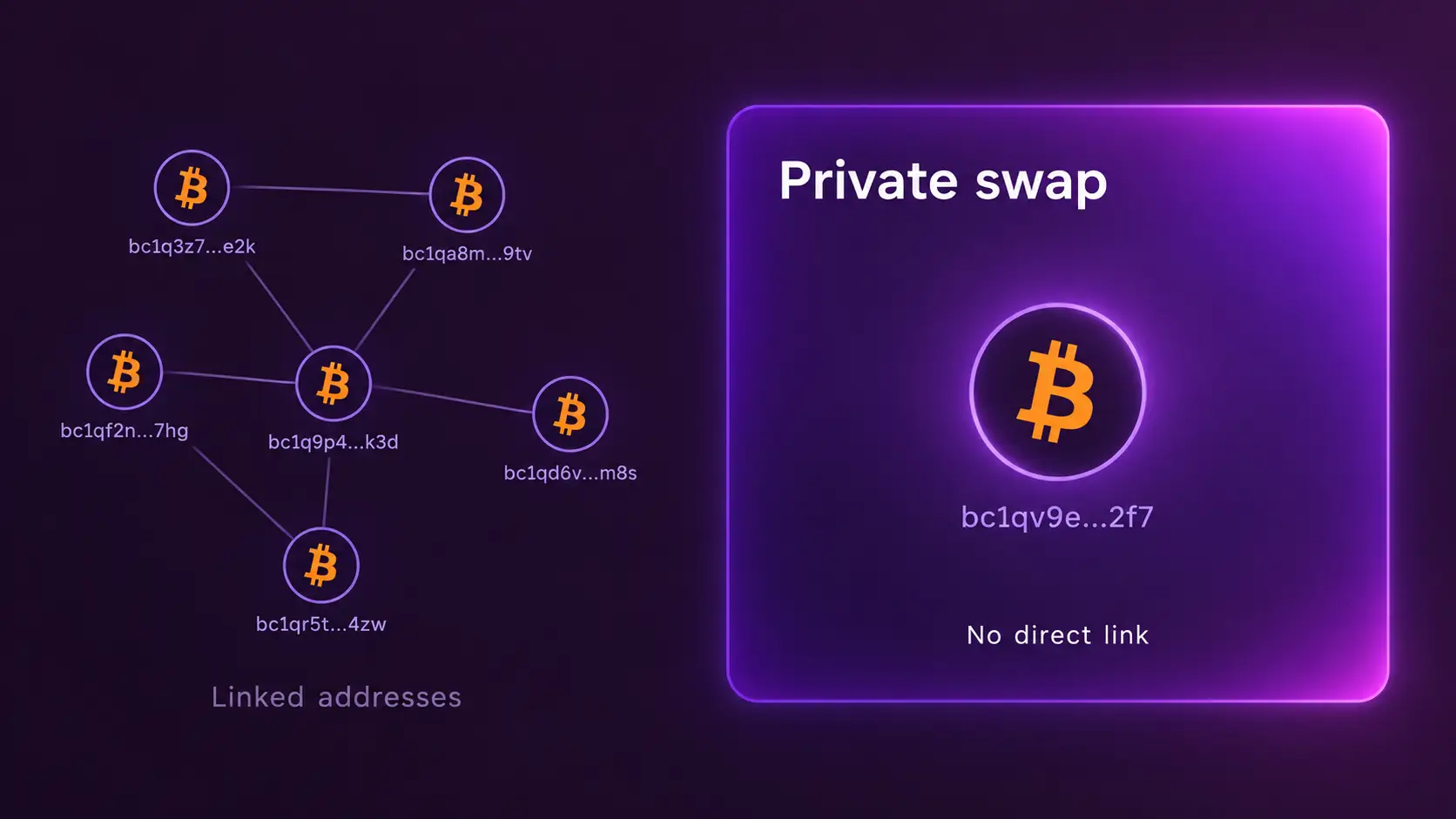
Bitcoin was never anonymous. It's pseudonymous. Your name isn't on the blockchain, but every transaction you've ever made is, forever.
That's fine until one address gets tied to you. Then your history becomes readable: what you hold, where it came from, where it went, and who you paid.
Swapping BTC into another asset doesn't reset any of that. A standard swap adds a fresh line to the record, connecting the address you sent from to the address you received at.
Here's what your Bitcoin address history reveals, why a normal swap links your addresses, and how to swap Bitcoin privately.
What the Bitcoin chain reveals
Paste a Bitcoin address into a block explorer like mempool.space and anyone can see its full history. But the bigger risk isn't one address. It's how addresses get grouped together.
Bitcoin doesn't use account balances. It uses UTXOs: individual chunks of BTC you've received. When you spend, your wallet combines chunks and sends any leftover back to you as change. That design leaks more than most people realise.
Analytics firms use these patterns to cluster thousands of addresses into one profile. Once a single address in that cluster is tied to you, the whole cluster is yours.
How a standard swap links your addresses
Say you swap 0.5 BTC for ETH. Your Bitcoin address sends 0.5 BTC to a swap provider's deposit address. A few minutes later, an Ethereum address receives the matching amount of ETH.
To an observer, that's two public records with:
- Matching value. 0.5 BTC in, the equivalent ETH out, minus fees.
- Matching timing. The two transactions happen minutes apart.
- A known counterparty. Swap providers' deposit and payout addresses are often labelled by analytics tools.
Put those together and your Bitcoin history now leads straight to your Ethereum wallet. Swapping across chains doesn't break the trail. It extends it. The same thing happens with any cross-chain move, which is why cross-chain swaps aren't private by default.
Bitcoin privacy options and their trade-offs
There's no single fix. Each option trades privacy against cost, convenience and risk.
If your goal is to swap BTC into another asset without your addresses being publicly connected, a non-custodial private swap does it in one step, without handing over custody or creating an account.
How to swap Bitcoin privately with Houdini
Houdini Private Swap breaks the direct onchain link between the address you send BTC from and the address that receives your new asset. Each private swap routes across two off-chain, non-custodial exchange partners and three separate blockchains, then delivers from a fresh, single-use wallet. Neither partner sees both ends of the route.
- Choose BTC as the asset you're sending, then pick the asset and chain you want to receive.
- Enter a receiving address with no public link to your Bitcoin address.
- Send your BTC to the one-time deposit address shown.
- Houdini routes the swap and delivers to your receiving address.
No account. No wallet connection. Houdini never holds your funds, and every swap goes through compliance controls, including sanctions screening.
Swap Bitcoin privately in Coinomi
Already holding BTC in Coinomi? Houdini is built into the wallet, so you can swap privately without leaving it. Private swaps are available whenever there's a private route for your pair. In Coinomi, just turn on the Private swap switch on the swap screen and Houdini handles the rest. Coinomi's guide on how to swap Bitcoin in Coinomi walks you through it step by step.
Keep it private after the swap
- Receive into a fresh address. Don't swap into a wallet that's already tied to your identity.
- Don't send it straight back. Moving the new asset back to your original address reconnects the two.
- Use a new Bitcoin address for every receive. Most modern wallets do this automatically.
Swap Bitcoin without the trail
Bitcoin is public by default. Your swaps don't have to be. Keep the utility. Lose the trail.
Start a private BTC swap on Houdini · Download Coinomi
FAQ
Is Bitcoin traceable? Yes. Every Bitcoin transaction is public and permanent. Your name isn't attached, but once one address is linked to you, analytics tools can often connect the rest.
Does swapping BTC to another coin hide where it came from? Not with a standard swap. Matching amounts and timing usually link the two sides.
Is a private swap the same as a mixer? No. Houdini doesn't pool user funds. It routes each swap through vetted exchange partners, and every swap goes through compliance screening.
Does Houdini hold my Bitcoin? No. Houdini is non-custodial. Your funds move through exchange partners and arrive at the address you choose.
Can I swap Bitcoin privately from my wallet? Yes. Houdini is built into wallets like Coinomi, so you can swap privately without leaving the app. Coinomi's step-by-step guide to swapping Bitcoin shows how.
